Rain Gardens for Indiana Homes: Turn Yard Runoff Into a Beautiful Landscape Feature
After a heavy Indiana rain, most homeowners want one thing: get the water out of the yard as quickly as possible.
But sometimes the better landscape solution is to give that water somewhere useful to go.
A rain garden is a shallow planted depression designed to temporarily collect runoff from roofs, downspouts, driveways, patios, or other parts of the property. Instead of sending all that water straight toward the street—or allowing it to sit beside the foundation—a rain garden slows it down, spreads it out, and gives it a chance to soak into the ground.
And unlike a drainage ditch, it can look like it belongs in the garden.
First: A Rain Garden Is Not a Pond
This is probably the biggest misconception.
A properly designed rain garden doesn't stay wet all the time. It fills during a rain event and then gradually drains. Most of the time, it simply looks like a planted landscape bed.
That distinction matters when choosing plants. Rain garden plants don't necessarily need to be aquatic plants. They need to tolerate the unusual cycle of briefly wet soil followed by normal—or sometimes fairly dry—conditions.
That makes many Indiana native plants especially useful.

Why Rain Gardens Make Sense in Indiana
Central Indiana gets plenty of intense rain events, and residential properties create a surprising amount of runoff.
Think about everything around a typical house that water can't easily penetrate:
Roofs
Driveways
Sidewalks
Patios
Compacted lawn
Garages and sheds
All of those surfaces move water somewhere else.
A rain garden intercepts a portion of that runoff before it leaves the property. The plants, soil, and root systems help slow the water and encourage infiltration.
For homeowners, that can mean a landscape feature that combines stormwater management with an actual garden.

Where Does a Rain Garden Go?
Location matters more than almost anything else.
A rain garden might receive water from a redirected downspout, capture runoff at the bottom of a slope, or sit near the edge of a patio or driveway. But it should not simply be placed wherever water already ponds without figuring out why that area is wet.
There is also an important distinction between a rain garden and a swale.
A swale moves water through the property.
A rain garden temporarily holds water so some of it can infiltrate.
Sometimes the two can work together. A swale can move stormwater toward an appropriately located rain garden, for example. But blocking or altering an existing drainage route without understanding where the water needs to go can create problems for both your property and your neighbors.

What Do You Plant in One?
This is where rain gardens get interesting.
Instead of treating drainage as something that has to be hidden, the planting can become a feature of the landscape.
A rain garden typically has different moisture zones. Plants toward the lowest portion need to tolerate temporary inundation. Plants higher along the edges experience shorter periods of moisture and can often tolerate considerably drier conditions.

For an Indiana garden, possibilities may include native plants such as:
Blue flag iris Iris virginica var. shrevei
Excellent for wetter portions of the garden, with upright foliage and violet-blue spring flowers.
Swamp milkweed Asclepias incarnata
A native milkweed that handles moisture better than common milkweed and provides important habitat for monarch butterflies.
Cardinal flower Lobelia cardinalis
One of our more dramatic native flowers, producing vivid red blooms in late summer.
Great blue lobelia Lobelia siphilitica
A blue-flowering counterpart that works particularly well in naturalistic plant combinations.
Fox sedge Carex vulpinoidea
A useful native sedge for creating the grassy structure that helps a rain garden feel integrated rather than simply filled with flowers.
New England aster Symphyotrichum novae-angliae
A strong late-season performer that provides fall color and pollinator value.
The exact palette should always respond to the site's sunlight, soil, drainage rate, available space, and how long water remains after a storm.
It Doesn't Have to Look Like a "Native Plant Garden"
Native planting and intentional design aren't opposites.
A rain garden can be loose and meadow-like, but it can also be organized with clearly defined edges, repeated plant groupings, ornamental grasses and sedges, natural stone, and a limited plant palette.
That distinction is important in residential landscapes.
The goal isn't to squeeze as many native species as possible into one bed. The goal is to build a coherent landscape composition that also performs a job.
A restrained palette repeated in larger groups will often look more intentional than dozens of individual species scattered throughout the garden.
And because La Madrina landscapes emphasize realistic Midwestern planting palettes, layered structure, and maintainable gardens, rain gardens fit naturally into that approach.
What About Mosquitoes?
A rain garden shouldn't become a mosquito pond.
Mosquitoes require standing water long enough to complete part of their life cycle. A functioning rain garden is designed to drain after a storm rather than remain continuously filled.
If water remains for days and days, that's a sign to investigate the soil, grading, outlet, garden depth, or another part of the drainage design.

Rain Gardens Aren't a Cure for Every Drainage Problem
This is the part that gets lost in pretty rain-garden photos.
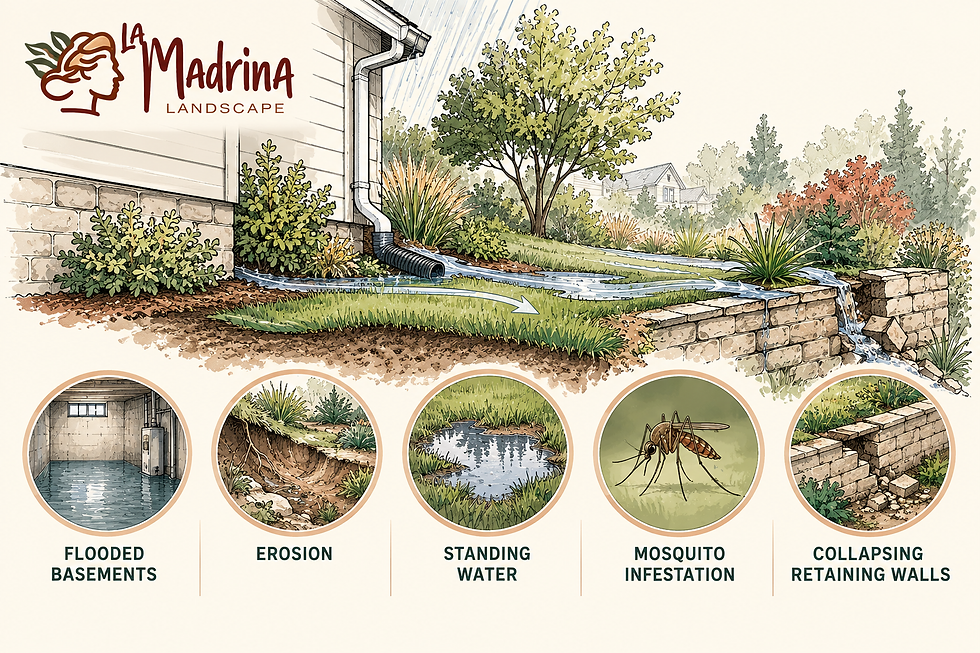
If water is entering your basement, flowing toward the foundation, backing up because of poor grading, or crossing neighboring properties through an established drainage route, adding plants isn't automatically the solution.
Sometimes the correct answer is grading.
Sometimes it's extending a downspout.
Sometimes it's a swale, drain, dry creek, or combination of systems.
And sometimes a rain garden is exactly what the property needs.
Drainage should be designed first. The garden comes second.
A Better Way to Think About Rain
For decades, residential landscapes were often designed around getting stormwater off the property as quickly as possible.
There is another option.
We can slow some of it down.
We can let soil absorb it.
We can use deep-rooted plants.
We can turn part of the drainage system into habitat and seasonal interest instead of treating water as something that simply needs to disappear.
A rain garden isn't appropriate for every yard. But on the right property, it can solve a practical landscape problem while creating something considerably better than another patch of struggling turf.
About La Madrina Landscape
At La Madrina Landscape, we design residential landscapes for real Midwestern homes and the people who live in them—balancing durable materials, regionally appropriate planting, functional site design, and four-season interest.
Because a good garden isn't just pretty when the weather cooperates.
It should know what to do when it rains, too.


Comments